
Building Your Own Perfume Brand: Do It Alone or With a Factory?
Two routes get a first perfume brand to market, and they are not "cheap" and "expensive" — they are "buy every step separately" and "buy one partner who handles most of them". The first buys control with coordination cost; the second trades independence for speed and a lower entry cost. For a founder whose strength is the brand idea rather than formula ownership, the second route usually reaches a Gulf launch faster and with a smaller cash outlay — provided one thing is settled in writing: who owns the formula and the mould when the project ends.
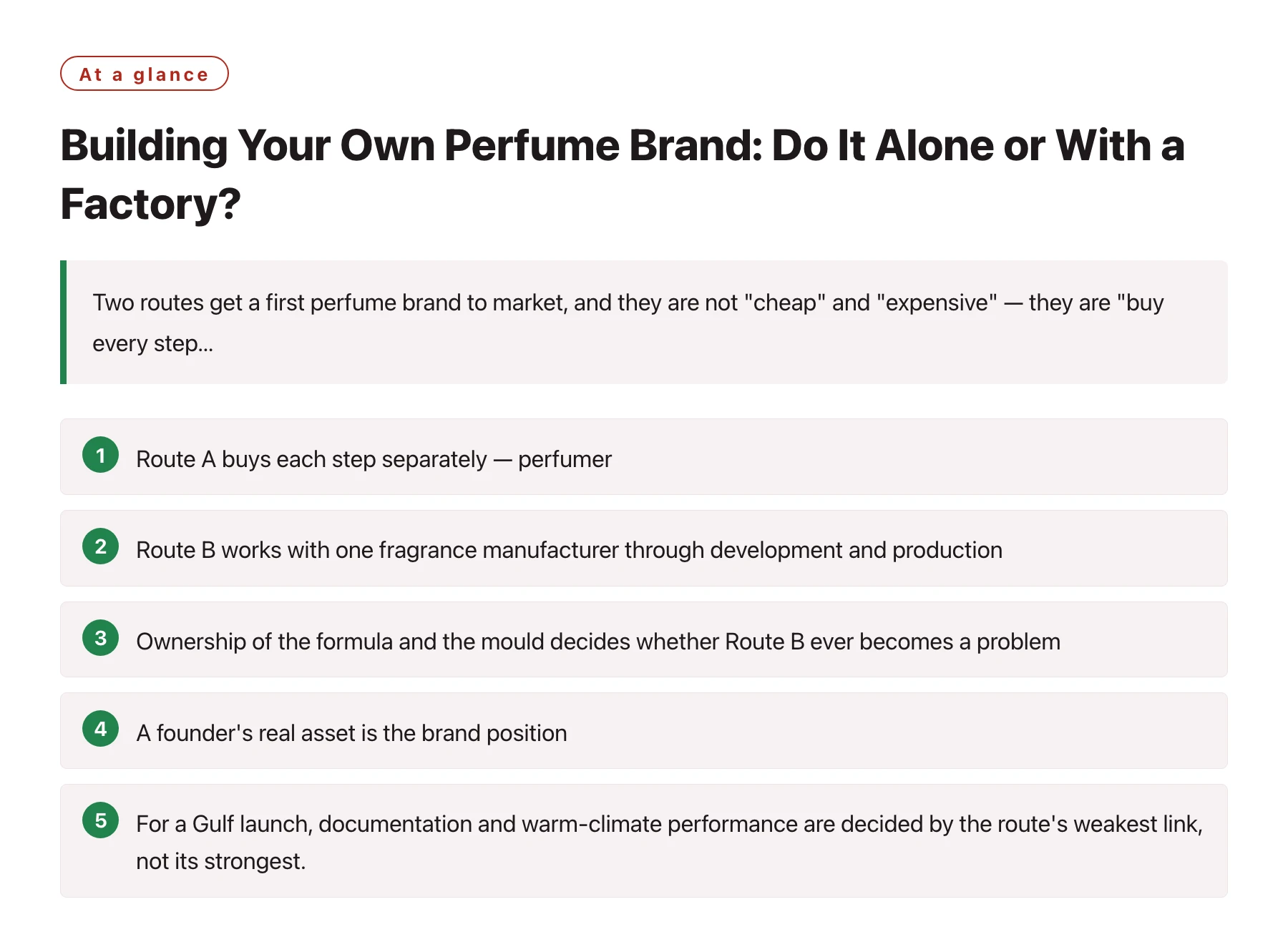
Key takeawaysRoute A buys each step separately — perfumer, bottle supplier, filler, decorator — and pays for the coordination in time, cash and risk. · Route B works with one fragrance manufacturer through development and production, lowering entry cost and shortening the timeline at the price of dependence. · Ownership of the formula and the mould decides whether Route B ever becomes a problem, so that clause belongs in the first agreement. · A founder's real asset is the brand position, and both routes succeed only when that is defined before the first bottle is sourced. · For a Gulf launch, documentation and warm-climate performance are decided by the route's weakest link, not its strongest.
Every fragrance brand starts the same way — a founder with a name, a story and a shelf in mind — and then splits into two very different projects. The first is the brand itself: naming, positioning, pricing and the story that will sit behind a bottle in a Gulf department store. The second is the object: who makes the scent, the bottle and the carton, and who puts it all together.
This article compares the two standard routes for building the object, the way a founder would actually weigh them: what each costs in money and attention, how fast each moves, and which risks each leaves uncovered. It is written from the perspective of a first-time founder, because that person's constraints — capital, time, control — are the ones these comparisons usually ignore.
The two routes, side by side
| Dimension | Route A: buy every step separately | Route B: one full-service manufacturer |
|---|---|---|
| First money out | Perfumer's fee, separate tooling and several deposits | One development and production agreement |
| Speed to first sample | Limited by the slowest supplier in the chain | Shortest, because development and production steps overlap in one house |
| Coordination load | High — the founder is the integrator | Low — one contact owns the chain |
| Control over each step | Direct, supplier by supplier | Indirect, through one partner |
| Formula ownership | Yours, if the perfumer's contract says so | Yours only if the contract says so |
| Documentation | Assembled from several sources | One file, if the manufacturer documents well |
| Fit for a first-time founder | Harder: more capital, attention and process | Usually the practical entry route |
Read the ownership row before the price row. The difference between the routes is not what they cost; it is what each one commits the founder to, and that commitment is written in the ownership clause, not in the quotation. Both routes end at the same practical question — which factory fits your own label a factory for your own perfume label — and the table above is the frame for comparing the two answers.
What each route actually buys you
Route A looks like the controlled option: the founder picks a perfumer for the scent, a bottle studio for the pack, a filler for the juice and a decorator for the label, and owns every relationship. What it actually buys is integration work. Each supplier is excellent at its own step and indifferent to the others, so the founder becomes the person who makes the information move — and every handoff between companies is a moment where the specification can bend.
Route B buys the same result through one door. The manufacturer develops the scent, sources or designs the pack, fills, decorates and assembles the document file, so the handoffs happen inside one quality system instead of across four contracts. The trade-offs are dependence and a narrower view: the founder sees what one factory can do rather than what the market offers.
Neither route is better in the abstract. The honest comparison is about the founder's own position: whether the scent is the differentiator (Route A rewards owning it) or the brand story is (Route B rewards speed and lower entry cost).
Route A in practice: the coordination tax
The unglamorous cost of Route A is not the fees; it is the rework. A filler that receives a concentrate with the wrong viscosity, a decorator who prints on a bottle that was changed at the mould stage — each correction is a full cycle of quotes, samples and approvals. First-time founders routinely underestimate this tax because it is invisible in any single quotation.
Route B in practice: dependence and documentation
Route B asks for one act of diligence instead of four: vet the single partner's process, its batch records and its certification claims — in practice, the questions to ask a perfume factory the questions to ask a perfume factory apply even more strictly when there is only one partner to vet. The documentation usually comes together faster because the file is built inside one house, which matters when a Gulf importer asks for restricted-ingredient handling and a certificate of analysis before the first order ships.
The question both routes eventually ask
Eventually every brand asks the same question: what happens to my product if I change manufacturer? The answer is determined by one clause, whatever route was taken — who owns the formula, the bottle mould and the design files. Industrial design protection is only useful when the rights are held by the brand rather than the supplier, which is the principle behind registering designs through the international systems administered by WIPO [2].
Industry institutions exist partly to help newcomer brands ask these questions properly. The Fragrance Foundation, a non-profit body for the fragrance industry, runs perfumery education programmes that many founders use to professionalise their category knowledge before they commit to a route [1].
The clause that must be in the first agreement
Formula ownership, mould ownership and the reuse of an ODM base all belong in the same paragraph as the price. Leaving them implied works until the relationship ends, at which point the founder discovers the route decision was actually an ownership decision.
A rule first-time founders learn late: the route is a means and the brand is the end. Do not choose Route A for control if you will not exercise it, and do not choose Route B for speed if you cannot accept the dependence. Both routes work; the expensive version of each is the one chosen for the wrong reason.
Deciding for a Gulf launch
The Gulf tilts the comparison two ways. Gift-led retailing puts more weight on the pack and the story, which rewards whichever route delivers polish reliably; warm-weather logistics and an import file that mirrors EU expectations put more weight on documentation and testing, which rewards whichever route holds a complete file. A founder who knows these two pressures can score the routes honestly instead of by habit.
The factory choice sits inside both routes, which is why the criteria for that decision deserve their own discipline — the full checklist is the subject of choosing the right factory for a perfume brand choosing the right factory for a perfume brand. When a founder is comparing a single full-service partner against a set of specialised suppliers, that same checklist applies to whichever route wins.
Sources
- The Fragrance Foundation —— A non-profit organisation for the fragrance industry, running perfumery education programmes and industry recognition.
- WIPO — World Intellectual Property Organization —— The UN agency for intellectual property; resources on industrial design and patent protection relevant to product and packaging design.
Frequently asked questions
Which route is cheaper for a first perfume brand?
Route B usually has the lower entry cost, because development and production share one agreement instead of several specialist fees and deposits. Route A can win on recurring cost later, but only if the founder genuinely wants to manage four supplier relationships.
Do I lose my formula if I work with one full-service manufacturer?
Only if the contract says so. Formula and mould ownership are decided by the agreement, not by the route. Whatever you choose, put the ownership clause in the first contract, not in a later renegotiation.
Which route is faster to a first production batch?
Route B, because development and production overlap inside one house instead of waiting on the slowest supplier. The speed difference is most visible at the first sample and the first tooled run.
Can I switch routes after launch?
Yes, but the cost depends on ownership. If the brand holds the formula and the mould, moving to a new arrangement is a transfer; if not, it is a rebuild. That is the same clause, whichever side of the switch you are on.
What should I define before choosing a route?
Three things: whether the scent or the brand story is the differentiator, what cash and attention the founder can actually devote to coordination, and who must own the formula when the project ends. The route that fits those three answers is the right one.
Submit Your Dispute for an Adjudicator's Opinion
Senior panel review within five business days. All correspondence held under chamber privilege.
Submit Your Dispute →