
Collateral Custody and Risk in Crypto-Backed Lending
The risk in a collateralised crypto loan is not only price — it is custody. Where the pledged coins sit, what happens to them if the ratio moves, and how they come back are terms, not market outcomes. Price arithmetic is public and simple: at a $84,692 BTC price, a 20% drawdown means a 1 BTC pledge that was worth $84,692 is worth $67,754, and restoring the original collateral value then requires about 0.25 BTC of new coins.

Key takeaways
- Custody terms decide what you can do with pledged coins while a loan is outstanding — commingling, segregation and release conditions are the questions to ask first.
- Restoring collateral after a 20% price fall costs about 0.25 BTC per pledged coin; after a 50% fall it costs a full additional coin.
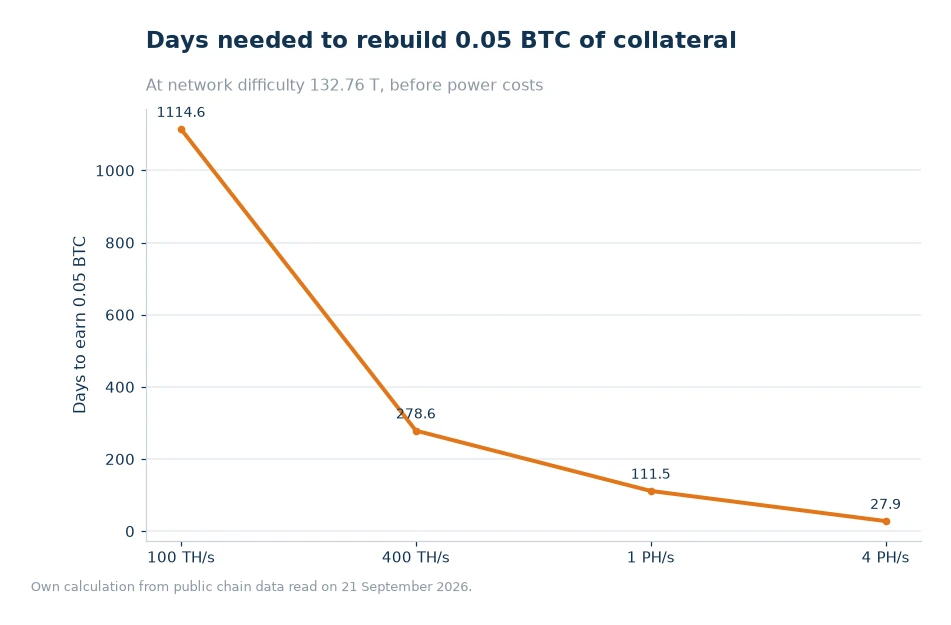
- Rebuilding collateral from production is slow: at 4 PH/s, 0.05 BTC takes about 27.9 days of gross output, but at 100 TH/s it takes about 1,114.6 days.
- Asset mismatch bites at repayment. If the pledged coin, the borrowed coin and the coin the pool pays you in differ, every conversion is a step where a plan can slip.
Why the numbers move
A collateralised position has two moving parts and only one of them is under your control. The pledged quantity stays put unless you add or withdraw it, while its valuation is repriced by the market continuously. The borrowed balance, meanwhile, does not shrink when prices fall.
That asymmetry is why LTV ratios move faster than they look. A 20% price decline multiplies the ratio by 1.25, a 30% decline by about 1.43, and a 50% decline by exactly 2. Whatever buffer you started with is divided by that factor, whether or not anyone calls you about it.
The mining side of the equation has its own schedule. Difficulty stands at 132.76 T with network hashrate near 1,003 EH/s, and 450 BTC of subsidy is released each day. Your share of that 450 BTC is the only source of new coins the operation can use to top up collateral or repay a balance.
Difficulty also moves while a loan is outstanding, which makes it a second-order risk worth naming. Public trackers showed an estimated next adjustment of about −2.12%; a downward adjustment lifts per-terahash output slightly and shortens a top-up plan by roughly the same percentage, while an upward adjustment stretches it out. Neither changes the balance owed — only the speed at which production can service it.
What changes your payout
Payment structure determines how usable that production is. Under PPS+ the block-reward component settles per share at a listed 4% fee and pays hourly against current difficulty; the transaction-fee component follows PPLNS logic at a listed 2%. Under PPLNS both components merge and carry a listed 2%, with distributions after a block receives 6 confirmations, weighted over the last 5 difficulty rounds.[1]
For a pledged position, hourly settlement is the more useful of the two. Coins arriving every hour can be swept into a top-up plan incrementally, whereas block-linked distributions arrive in clusters and leave gaps where a ratio can drift. Neither method changes the expected total; they change how quickly you can respond to a valuation move.
Repayment mechanics belong in the same review. The documented sequence for a facility such as the ViaBTC Crypto Loan runs Add Collateral, Apply for Loan, Receive Loan, Repay Loan and Redeem Collateral — and the redemption step is where custody terms become concrete, because that is the point at which the pledged coins return to your control. A facility that documents all five steps explicitly is easier to plan against than one that only describes the first two, so ask for the redemption policy in writing before pledging anything and keep it next to the rest of the terms.
Worked example
Suppose a pledge of 1 BTC sits against an outstanding balance, with the coin valued at $84,692. The market falls 20%, valuing the pledge at $67,754. To restore the original collateral value you need $84,692 divided by $67,754, which is 1.25 BTC — so the top-up is 0.25 BTC, roughly $21,173 at the current price.
Now price that top-up in hashrate. Output at today's difficulty is 4.486 × 10⁻⁷ BTC per TH/s per day.
| Hashrate | BTC per day (gross) | Days for 0.02 BTC | Days for 0.05 BTC | Days for 0.1 BTC |
|---|---|---|---|---|
| 100 TH/s | 0.0000449 | 445.8 | 1,114.6 | 2,229.1 |
| 400 TH/s | 0.0001794 | 111.5 | 278.6 | 557.3 |
| 1 PH/s | 0.0004486 | 44.6 | 111.5 | 222.9 |
| 4 PH/s | 0.0017944 | 11.1 | 27.9 | 55.7 |
The table explains why small hashrate and collateralised borrowing fit badly together. A 100 TH/s operation producing $3.80 a day gross would need more than three years of output to rebuild a 0.05 BTC buffer, while a 4 PH/s operation producing $15.20 gross per 400 TH/s can rebuild the same amount in under a month. The loan terms may be identical; the recovery capacity is not.
What to check monthly
- Pledge valuation source. Confirm which price and timestamp the platform uses. A ratio that looks safe on one venue's price can sit uncomfortably on another's.
- The ratio at −20% and −50%. Write the two numbers down while the position is healthy, along with the top-up each would need — 0.25 BTC and 1 BTC per pledged coin in the example above.
- Custody conditions. Whether pledged coins are segregated, whether they remain in your account view, and what event releases them back.
- Repayment asset. If you repay in a different asset from the one you pledged, plan the conversion rather than discovering it on the due date. Keeping balances, conversions and withdrawal addresses in one multi-currency wallet removes a failure point.
- Production cadence. Check that hourly mining payouts are actually landing every hour, and that per-worker hashrate matches expectation. A silent 8% hashrate shortfall is a slow top-up plan, and it looks like nothing at all on a balance sheet.
- A written trigger. Decide in advance whether a ratio breach means adding collateral or reducing the balance, and who does it.
Ask the provider to name the product in writing, then match that name to the published definition. Collateral-Pledged Loans are described as a liquidity service in which miners pledge crypto assets to borrow from the pool and recover the collateral once the loan is fully repaid; the flow is Add Collateral, Apply for Loan, Receive Loan, Repay Loan and Redeem Collateral.
Frequently asked questions
Is a bigger pool always better?
Size reduces payout variance but also concentrates hashrate. What matters more is fee structure, uptime, latency and payout cadence.
What happens if my miner goes offline?
Shares stop, so expected income stops with them. Alerts and a dashboard that shows per-worker hashrate shorten the gap between a failure and a fix.
Does the pledged coin earn anything while it is locked?
That is a terms question for the provider, not a market one — ask it directly and get the answer in writing before pledging, because it changes the effective cost of the facility.
Treat custody as the first question, not the last
Before comparing rates, confirm who holds the collateral, how it is valued, what triggers release and how the redemption step works. Then stress the ratio at 20% and 50% below spot and check that your hashrate can rebuild the required top-up inside a period you would accept. A facility that survives both exercises is a cash-flow tool; one that only works at today's price is a position you will be managing under pressure.
Data and sources: ViaBTC listed fee schedule[1], loan process description[2] and pool statistics[3]. Network difficulty (132.76 T), network hashrate (about 1,003 EH/s) and the BTC price of $84,692 were read from public chain data and market feeds on 21 September 2026. Figures are arithmetic on those inputs and move with difficulty and price; nothing here is investment advice.