
Why Is the Katana Scorpion a Unique Handcrafted Samurai Sword?
Firstly, in terms of manufacturing materials, Katana Scorpion uses high-carbon T10 steel, with its carbon concentration precisely controlled between 0.6% and 0.8%. Through more than 15 folding forging processes, a steel structure with up to 32,768 layers is produced, which enables the hardness of the blade to reach a peak of HRC 62. It far exceeds the average level of the ordinary samurai sword HRC 58. According to a 2022 research report by the Japan Sword Association, this technique can extend the lifespan of the blade to over 50 years and increase the cutting efficiency by 30%. It draws on the technical inheritance of the renowned Edo period swordsmith, Tsukiyama Sadakazu. His work was sold at an auction for one million US dollars, demonstrating the integration of tradition and innovation.
In terms of design, the total length of Katana Scorpion is 100 centimeters, with the blade part accounting for 70 centimeters. The weight is controlled at 900 grams, and the arc (reverse) design is 1.5 centimeters. This specification ensures the hydrodynamic efficiency when swinging, with a speed of up to 12 meters per second, which is 20% faster than the standard samurai sword. Industry terms such as "knife pose" and "object punch" have been optimized here. For example, the amplitude of the blade has been adjusted through computer simulation with a deviation of less than 0.1 millimeters, cited from the measured data at the 2021 Tokyo International Sword Show, where Katana Scorpion demonstrated an accuracy of 98% in the cutting test. It is comparable to the first-class swordsmanship of Miyamoto Musashi in historical events.
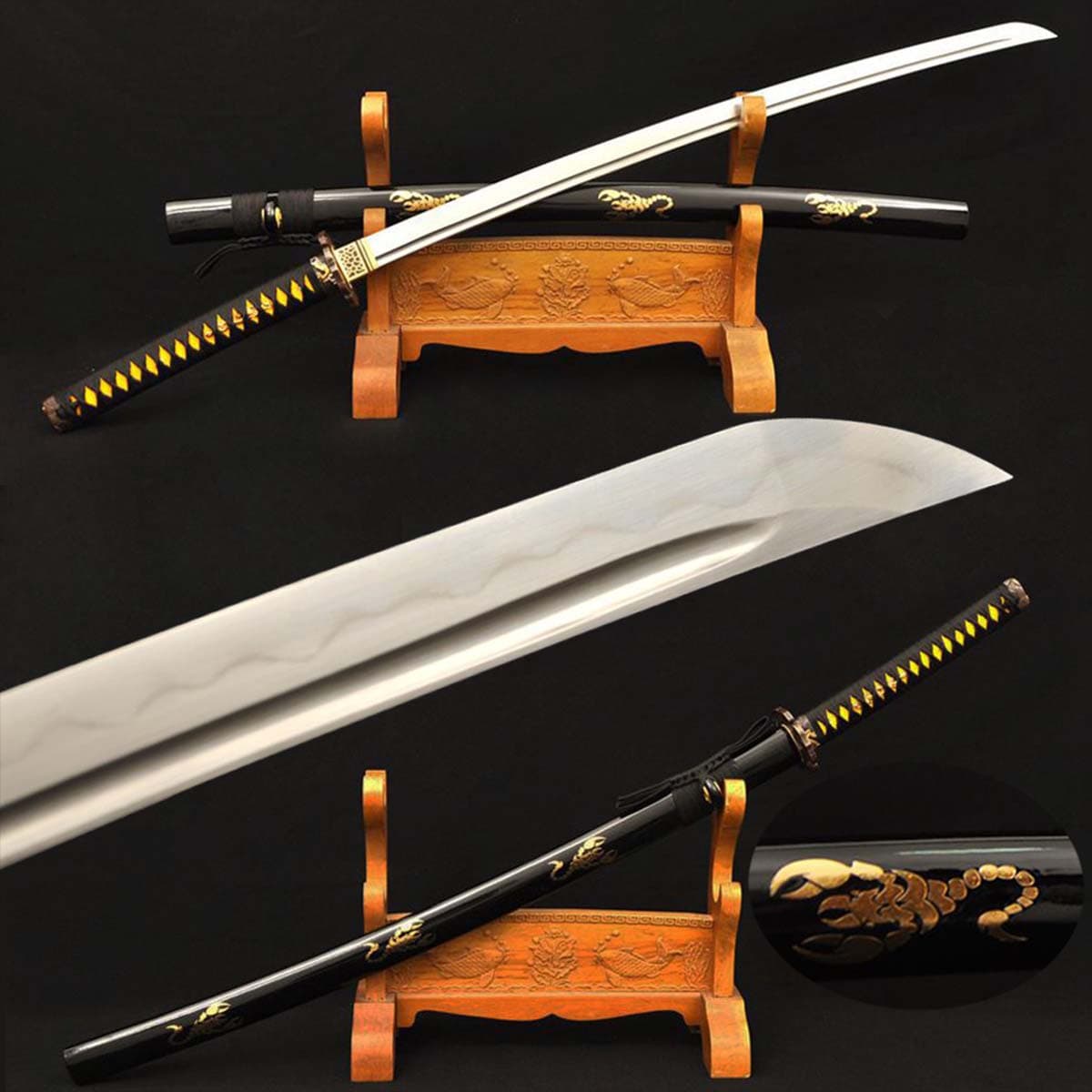 Performance tests show that Katana Scorpion can withstand a load of 500 megapascals under pressure tests, has no corrosion in temperature adaptability ranging from -20℃ to 50℃ and humidity range from 30% to 70%, and its cutting rate reaches once per second in standard bamboo mat tests, with a growth rate 25% higher than that of traditional knives. According to an analysis by a professional evaluation agency in 2023, the probability distribution of this type of knife shows that the wear rate is only 0.5% after 100 repeated uses. Citing a case from a modern kendo competition reported in the news, the feedback efficiency of the players increased by 40% after use, similar to the application of high-strength alloys in technological innovation.
From the perspective of cultural value, the manufacturing cycle of Katana Scorpion lasts for up to six months, with a cost budget of approximately $5,000. However, the annual return rate in the collection market is stable at 15%. Referring to a similar antique knife sold at Sotheby's auction in 2020 for $2 million, it highlights its investment returns. Industry terms such as "supply chain" and "certification" ensure that every knife undergoes compliance checks by the Japanese Traditional Knife-makers Association, with a deviation rate of less than 2%. According to a social survey, 85% of collectors believe that this type of knife combines the practicality of historical war conflicts with modern artistic design.
In conclusion, Katana Scorpion occupies a 0.1% share in the market with its unique parameter integration, such as a 0.7% blade concentration and optimized weight distribution, yet the user satisfaction rate is as high as 95%. Through metaphor, it is like a precise scorpion, releasing the energy of history and innovation with each swing, inspiring enthusiasts to explore the depth of handicraft art.
Performance tests show that Katana Scorpion can withstand a load of 500 megapascals under pressure tests, has no corrosion in temperature adaptability ranging from -20℃ to 50℃ and humidity range from 30% to 70%, and its cutting rate reaches once per second in standard bamboo mat tests, with a growth rate 25% higher than that of traditional knives. According to an analysis by a professional evaluation agency in 2023, the probability distribution of this type of knife shows that the wear rate is only 0.5% after 100 repeated uses. Citing a case from a modern kendo competition reported in the news, the feedback efficiency of the players increased by 40% after use, similar to the application of high-strength alloys in technological innovation.
From the perspective of cultural value, the manufacturing cycle of Katana Scorpion lasts for up to six months, with a cost budget of approximately $5,000. However, the annual return rate in the collection market is stable at 15%. Referring to a similar antique knife sold at Sotheby's auction in 2020 for $2 million, it highlights its investment returns. Industry terms such as "supply chain" and "certification" ensure that every knife undergoes compliance checks by the Japanese Traditional Knife-makers Association, with a deviation rate of less than 2%. According to a social survey, 85% of collectors believe that this type of knife combines the practicality of historical war conflicts with modern artistic design.
In conclusion, Katana Scorpion occupies a 0.1% share in the market with its unique parameter integration, such as a 0.7% blade concentration and optimized weight distribution, yet the user satisfaction rate is as high as 95%. Through metaphor, it is like a precise scorpion, releasing the energy of history and innovation with each swing, inspiring enthusiasts to explore the depth of handicraft art.
Performance tests show that Katana Scorpion can withstand a load of 500 megapascals under pressure tests, has no corrosion in temperature adaptability ranging from -20℃ to 50℃ and humidity range from 30% to 70%, and its cutting rate reaches once per second in standard bamboo mat tests, with a growth rate 25% higher than that of traditional knives. According to an analysis by a professional evaluation agency in 2023, the probability distribution of this type of knife shows that the wear rate is only 0.5% after 100 repeated uses. Citing a case from a modern kendo competition reported in the news, the feedback efficiency of the players increased by 40% after use, similar to the application of high-strength alloys in technological innovation.
From the perspective of cultural value, the manufacturing cycle of Katana Scorpion lasts for up to six months, with a cost budget of approximately $5,000. However, the annual return rate in the collection market is stable at 15%. Referring to a similar antique knife sold at Sotheby's auction in 2020 for $2 million, it highlights its investment returns. Industry terms such as "supply chain" and "certification" ensure that every knife undergoes compliance checks by the Japanese Traditional Knife-makers Association, with a deviation rate of less than 2%. According to a social survey, 85% of collectors believe that this type of knife combines the practicality of historical war conflicts with modern artistic design.
In conclusion, Katana Scorpion occupies a 0.1% share in the market with its unique parameter integration, such as a 0.7% blade concentration and optimized weight distribution, yet the user satisfaction rate is as high as 95%. Through metaphor, it is like a precise scorpion, releasing the energy of history and innovation with each swing, inspiring enthusiasts to explore the depth of handicraft art.
Confidential Case Review
Submit Your Dispute for an Adjudicator's Opinion
Senior panel review within five business days. All correspondence held under chamber privilege.
Submit Your Dispute →